 Cetus protocol
 swaps and liquidity range choices
Cetus protocol lets users swap tokens and supply liquidity within selected price ranges through its concentrated liquidity pools. Swapping exchanges assets; providing liquidity commits assets to trading activity. The range determines when a position participates in swaps, while market movement changes its token composition and potential earnings.
Updated ·
Contents
Preparing a swap and confirming the received tokens
A swap requires a compatible wallet, assets on the selected network, and enough native currency for transaction costs. Cetus centers its trading products on Sui and also maintains a separate Aptos version. Network selection matters because balances and pool positions belong to their respective chains. The Sui aggregator can draw liquidity from multiple sources, so a Cetus swap need not use only a Cetus pool.
Review the quote before signing
Choose the input and output tokens, then inspect the amount that the quote would return. Check token identities rather than relying solely on their symbols. Review the route and price impact before authorizing the transaction. For an exact-input swap, check the minimum acceptable output; for an exact-output swap, check the maximum acceptable input. Raising slippage tolerance permits a worse execution result; it does not improve the underlying quote. The supported swap functions enforce an amount limit that depends on whether the trade fixes its input or output.
Read the transaction result
After submission, inspect execution status and the recorded token changes. A wallet signature authorizes an action; successful execution establishes whether that action occurred. Compare the received token identity and amount with the signed terms. If the interface remains pending, inspect the transaction record before submitting another trade.
What happens when a CLMM position leaves its range?
A CLMM position stops earning new swap fees while the pool price remains outside its selected range. CLMM means concentrated liquidity market maker. Its range boundaries define where the deposited liquidity participates in trading. Ticks divide the price curve into intervals, and the pool's tick spacing constrains the boundaries that a position can use.
Price movement also changes the assets that the position holds. As trading carries the price through the range, the position progressively exchanges one token for the other. Outside the range, its underlying liquidity consists of one side of the pair. Returning inside the range restores participation in swaps, provided the position retains liquidity. A narrow range concentrates capital more strongly around selected prices, but a smaller price movement can carry it outside those boundaries.
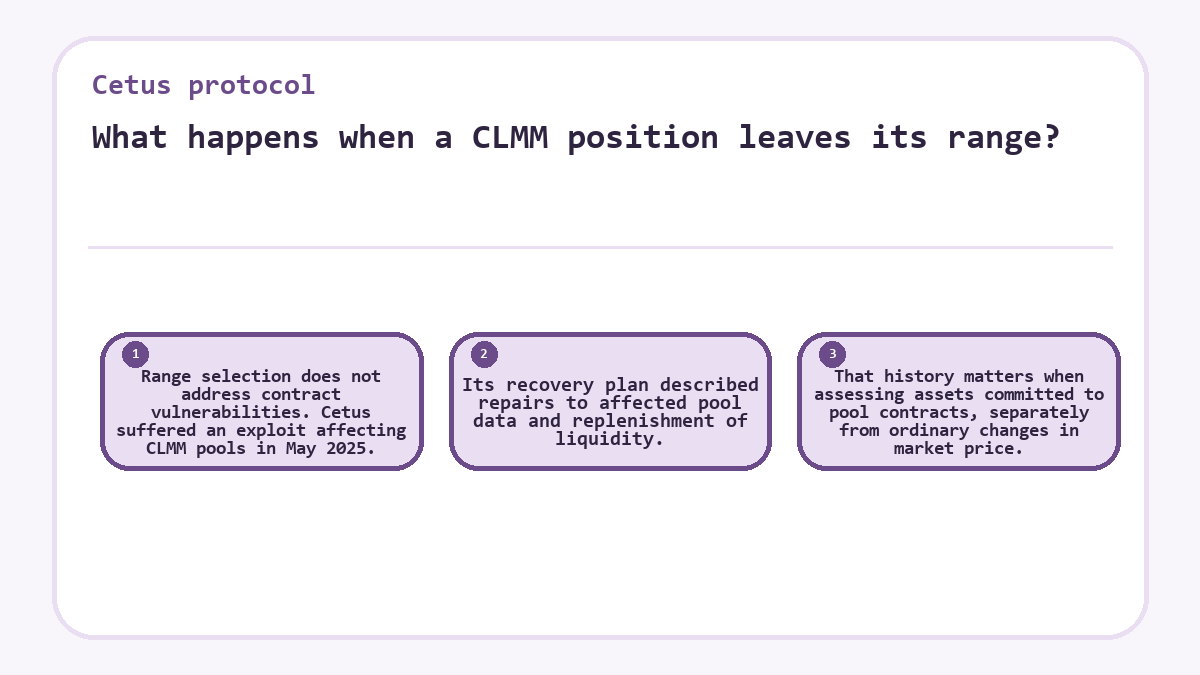
Range selection does not address contract vulnerabilities. Cetus suffered an exploit affecting CLMM pools in May 2025. Its recovery plan described repairs to affected pool data and replenishment of liquidity. That history matters when assessing assets committed to pool contracts, separately from ordinary changes in market price.
Which costs determine a swap or liquidity position's outcome?
Swap fees, execution price, and network charges determine trading costs; liquidity positions also face changes in their underlying asset value. The pool fee and price impact measure different things. A lower fee does not necessarily produce a better quote when the available liquidity causes greater price movement. Compare the net receiving amount for the same proposed trade.
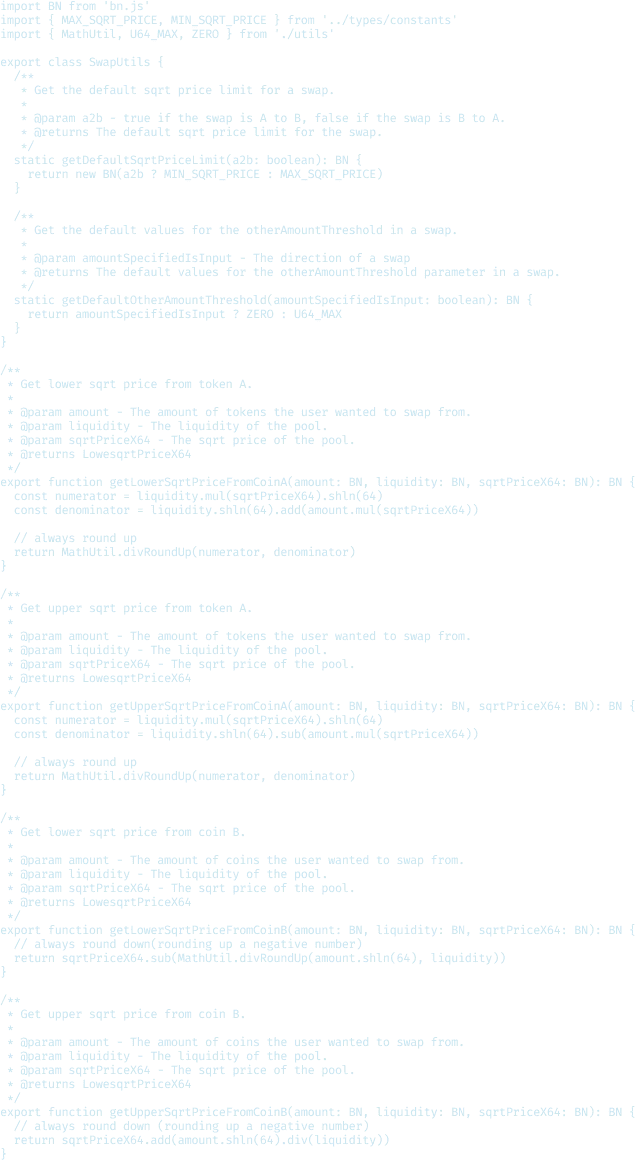
Cetus CLMM distributes the liquidity providers' portion of swap fees proportionally among the liquidity active during each swap. The pool's fee tier and the protocol's fee share determine the amount available for that distribution. These are configuration inputs, so use the selected pool's applicable settings when evaluating earnings.
Trading volume, competing active liquidity, and time inside the range affect a position's fee income. Incentive rewards add a separate component where a pool provides them. An annualized return display projects activity over time; it does not establish the position's eventual profit. Impermanent loss measures the difference between providing liquidity and holding the corresponding assets, before accounting for earnings. Fees and rewards may fail to offset that difference.
A wider range changes participation after the same price move
Consider a hypothetical CLMM deposit with a fixed token pair and the same starting capital. Every market state in this example is hypothetical. Compare a narrow range around the starting price with a wider range that contains it. The narrower choice concentrates capital more strongly; the wider choice covers additional prices.
Before depositing, the liquidity provider reviews the pool price and token amounts required for the narrow range. After authorizing the deposit, the transaction succeeds. The resulting position shows the intended pool, selected boundaries, and nonzero liquidity. Those records establish that the deposit completed.
The liquidity provider then finds that the pool price has moved outside the narrow range, but remains inside the wider alternative. The observed position is inactive even though its creation succeeded. Under the wider choice, it would remain eligible to participate in swaps at that price. Widening the range spreads the same capital across more prices, allowing continued participation after this hypothetical movement. It does not establish which range would earn more overall.
Choosing liquidity positions, managed exposure, or trading orders
Cetus supports different liquidity structures and management approaches. Identify the pool or product before applying a range rule, because its mechanics determine what the deposited assets do.
Direct CLMM positions and DLMM bins
A direct CLMM position gives its owner explicit lower and upper range boundaries. Cetus also has a dynamic liquidity market maker, or DLMM, that organizes liquidity into discrete price bins and uses volatility-sensitive fees. Bin allocation and dynamic fees create different management decisions from a CLMM position's tick range. Do not treat their liquidity displays or fee settings as interchangeable.
Vault management and trading orders
Cetus Vault automates liquidity management. That changes who or what manages the allocation, while the underlying assets retain market exposure. Review the particular strategy and withdrawal conditions before committing funds. Cetus also offers limit orders and recurring purchases through its trading products. These serve an execution objective rather than the objective of maintaining a liquidity position. A submitted order and a filled order represent different states.
How do you leave a Cetus liquidity position?
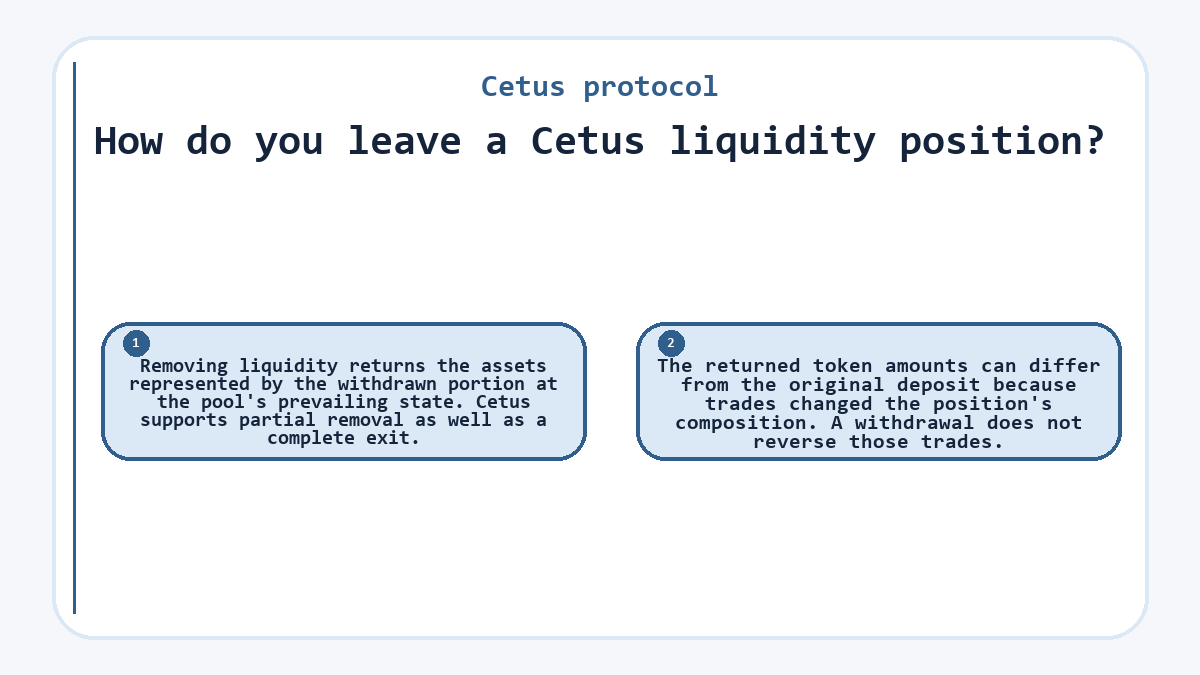
Removing liquidity returns the assets represented by the withdrawn portion at the pool's prevailing state. Cetus supports partial removal as well as a complete exit. The returned token amounts can differ from the original deposit because trades changed the position's composition. A withdrawal does not reverse those trades.
Fee collection, reward collection, liquidity removal, and position closure are distinct protocol operations, although an interface can combine them. On Sui, a CLMM position has a position object containing its pool, boundaries, and liquidity. After an exit, inspect the remaining liquidity and returned balances. If you requested complete closure, check the transaction result, allowing for the recovery plan's exception: position NFTs affected by the May 2025 exploit remain as compensation certificates even after full liquidity withdrawal. An empty position object and an active deposit are different states.
Everyday questions about Cetus protocol
Can one Cetus pool hold several positions from the same wallet?
Cetus CLMM supports multiple positions in the same pool with separate price ranges. Each position can therefore cover a different interval. Their shared token pair does not make their exposure identical: range boundaries determine where each position contributes liquidity. Evaluate their combined asset exposure as well as their individual balances.
Does claiming swap fees automatically increase my CLMM liquidity?
Claiming swap fees does not automatically reinvest them into a direct CLMM position. Cetus accounts for those fees separately from deposited liquidity. Increasing the position requires an additional liquidity operation. A vault can apply its own reinvestment strategy, so a direct position's fee treatment should not substitute for the terms of a managed product.
Is supplying just one token possible in a Cetus CLMM position?
A CLMM position entirely outside the current price can contain only one token. Which token it requires depends on the range's location and the pool's token ordering. A range spanning the current price generally requires both tokens. Single-token entry therefore changes the position's initial exposure and participation; it is not simply an alternative payment method for the same allocation.
What does holding CETUS entitle me to receive from a liquidity pool?
Holding CETUS alone does not create a liquidity position or entitle the holder to that pool's swap fees. CETUS is the protocol token, while liquidity participation requires depositing assets into a position. Token incentive programs also have participation conditions. Keep a wallet's CETUS balance separate from the liquidity and earnings recorded for its pool positions.
Will a successful swap guarantee the next swap receives the same rate?
A completed swap establishes its own execution result, not the rate available for another transaction. Later quotes reflect the pool state and available liquidity at that time. Other trades and the proposed trade's size can change the receiving amount. A previous successful transaction therefore cannot replace reviewing the next quote and its minimum output.