 Cetus protocol
 pool fee claims and wallet receipt checks
Cetus protocol lets you collect accrued trading fees from its concentrated liquidity market maker (CLMM) pools into your wallet without withdrawing the liquidity that earned them. For a directly held position, a fee-only claim leaves its liquidity amount and selected price range unchanged. The collected tokens become wallet assets; collection alone does not reinvest them. Start with the correct position and its claimable token amounts, then review the transaction before signing. Completion means a successful transaction with the expected receipts at your address. A smaller earnings counter alone does not establish receipt, and the position's displayed market value does not measure whether its liquidity amount changed.
Updated ·
The short version: A fee-only claim transfers accrued earnings to your wallet while leaving your position's liquidity amount and price range unchanged.
Choose fee collection when the position should stay open
Use the fee-collection action when your intended outcome is to receive accrued earnings while keeping the existing position. Removing liquidity serves a different purpose: it takes deposited assets out of that position. Closing it goes further and ends the position. A transaction that combines those operations needs a different review from a fee-only claim.
Cetus CLMM accumulates trading fees separately from the liquidity that providers deposit. This separation makes collection possible without reducing the position. Leaving earnings unclaimed also does not add them to its liquidity. Reinvestment requires an additional liquidity operation, with the token requirements that apply to that position.
Match the claim to the position you control
Position identity and token amounts
The claim must target the position that earned the fees, with its matching pool and token types. A token-pair label alone does not establish that match. Record the position identifier, accrued amounts, liquidity amount, and price range before proceeding.
Cetus identifies the pool and position separately in its collection operation. These identifiers distinguish the claim even when several positions involve the same assets. Token quantities provide a clearer comparison than a combined currency valuation, which also responds to market prices.
Authority and transaction contents
The signing account must have the authority required to use the position. A wallet connection establishes which account the interface is showing; it does not establish that every displayed position belongs to that account. A missing or inaccessible position needs an ownership check before any claim attempt.
Review the proposed operations and recipient alongside the network fee. For this task, the transaction should collect earnings and deliver them to your intended wallet. Unexpected liquidity removal, position closure, or token conversion changes the requested outcome.
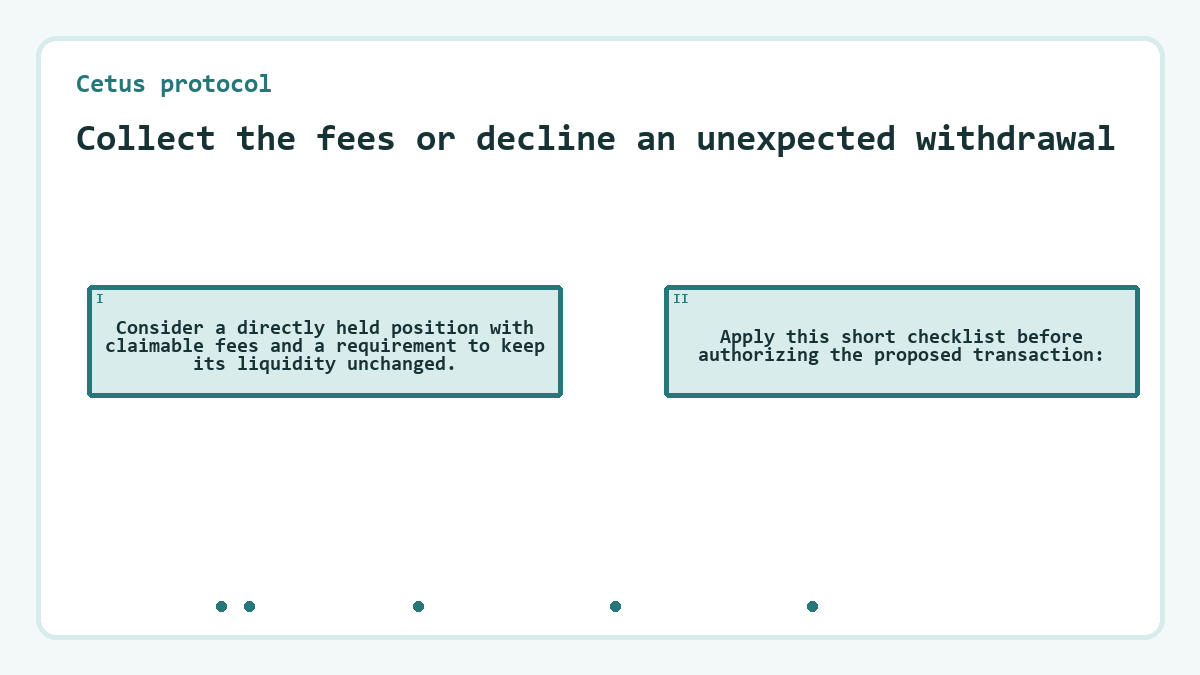
Collect the fees or decline an unexpected withdrawal
Consider a directly held position with claimable fees and a requirement to keep its liquidity unchanged. Apply this short checklist before authorizing the proposed transaction:
- Match the connected account to the position that holds the accrued fees.
- Match the position identifier, pool, and token types to your starting record.
- Confirm that the proposal collects fees without removing liquidity or closing the position.
- Check the intended recipient and the displayed network fee.
- Proceed only when the proposed effects fit that fee-only outcome.
A matching fee-only proposal
Approve the matching transaction, then inspect its execution status and token receipts. Compare the position's liquidity amount and range with your starting record. A successful receipt at the intended address, alongside unchanged liquidity and range, completes the claim. Stop there if your purpose was to move earnings into the wallet.
A proposal that also removes liquidity
Decline a proposal that includes withdrawal when the position must remain intact. Use the same comparison: account, position, recipient, and liquidity effect. Rejecting the unsigned proposal leaves that proposed withdrawal unexecuted. Inspect the refreshed position before preparing a fee-only action; do not approve the withdrawal merely because it also collects earnings.
Which tokens arrive when you claim pool fees?
A fee claim collects the pool tokens that the position has accrued, with amounts determined by trading activity and its eligible liquidity share.
Swap direction affects the composition of those earnings because the pool charges trading fees in each swap's input token. The accrued amounts therefore need not have equal quantities or equal values. Collection does not automatically convert them into a preferred asset. Any conversion adds a swap, with its own execution conditions and costs.
What does a fee claim cost?
A fee claim requires a blockchain transaction, so the proposed network charge belongs in the decision about whether to collect now. Use the estimate for the actual transaction rather than assuming a fixed collection cost. Simulation can estimate gas and expose proposed effects before signing.
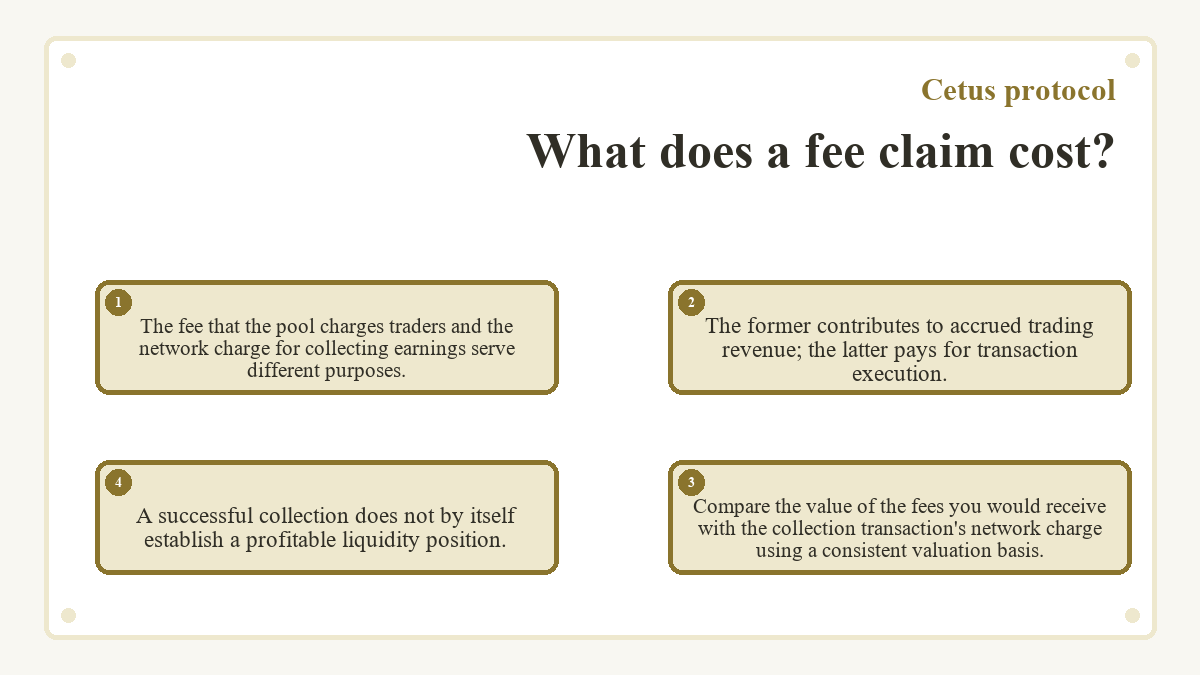
The fee that the pool charges traders and the network charge for collecting earnings serve different purposes. The former contributes to accrued trading revenue; the latter pays for transaction execution. Compare the value of the fees you would receive with the collection transaction's network charge using a consistent valuation basis. A successful collection does not by itself establish a profitable liquidity position.
Why can the fee display differ after a successful claim?
The fee display can differ because the interface reads delayed data or because further eligible swaps generate earnings after collection. A displayed balance is a snapshot.
The transaction record provides the execution status and balance changes for affected addresses and token types. It can distinguish a completed receipt from an interface refresh problem. A transaction identifier alone does not establish success: an executed transaction can still report failure. If the outcome remains unresolved, inspect that transaction before submitting another claim.
Indexed reads can trail execution, so a wallet or position view may update afterward. Compare token quantities once the view reflects the transaction. If the received asset also pays the network fee, account for that charge when interpreting its net balance change.
The existing range still governs future fee earnings
Cetus CLMM distributes swap fees to liquidity that is in range when the swap occurs. Collecting past earnings does not move the range or restore an inactive position to participation. The claim changes where accrued tokens sit, while the existing liquidity remains exposed to pool activity and price movement. Adjusting liquidity is a separate decision from receiving accrued fees.
Common questions about Cetus protocol
Are liquidity mining rewards included in every Cetus fee claim?
Liquidity mining rewards use a separate collection operation, so a fee claim does not establish that those rewards were collected. An application can combine the operations in one transaction. Check which operations the proposal includes and which token receipts the completed transaction records.
Does swap slippage tolerance control a fee-only claim?
A fee-only collection does not execute a swap, so swap slippage tolerance does not govern that collection. If the transaction also converts the collected tokens, that added swap has its own output conditions. Review the conversion separately before approving a combined action.
How are vault earnings different from fees on a directly held position?
A vault manages underlying liquidity positions and can reinvest their fees and rewards. Holding a vault share therefore differs from controlling an individual CLMM position for direct collection. The vault's withdrawal and earnings mechanics determine what its depositor receives; the direct-position claim procedure does not establish those outcomes.
Can a different connected account collect my position's fees?
Changing the connected account does not transfer authority over the position. Collection requires access to the position under its ownership or custody arrangement. If the new account cannot use that position, reconnecting alone will not make the fees claimable from it.
Is a pool fee claim the same as realizing the position's total profit?
A pool fee claim transfers accrued tokens to your wallet; it does not establish the position's total profit. The remaining assets can change in value and composition, and transaction costs also affect the outcome. Keep the collected token amounts separate from changes in the value of the liquidity that remains deposited.