 Cetus protocol
Protocol pool mechanics determine how Cetus swaps move prices
Protocol rules in Cetus concentrated liquidity market maker (CLMM) pools connect swap price impact to trade size and the liquidity available across the traded price range. Concentrated liquidity supports swaps within the ranges that liquidity providers select. A trade moves the pool price as it exchanges tokens, and crossing range boundaries can change the available depth. Larger trades can therefore receive progressively worse rates, especially beyond a dense liquidity band. Slippage tolerance limits acceptable execution changes; it does not add liquidity or improve the underlying quote.
Updated ·
Compare the quote before loosening the output limit
When an exact-input quote already reflects substantial price impact, its expected output deserves attention before any change to slippage tolerance. Exact-input means fixing the amount to spend. The quote estimates the output for that amount against the available liquidity, while the minimum-output limit defines the lowest acceptable receipt.
A quote can closely match execution and still represent an unfavorable exchange. Price impact concerns the trade's effect on pricing. Execution slippage concerns the difference between the quote and the eventual fill. A narrow tolerance does not correct an unfavorable starting quote.
If changing pool conditions make the minimum output unattainable, that protection can prevent the swap from completing. Refreshing the quote addresses the outdated estimate. Reducing the input addresses trade size relative to depth. Those responses change different parts of the problem.
Increasing tolerance permits more deviation from the quote. It supplies no additional tokens to the pool and does not repair thin liquidity. The useful recovery depends on whether the problem lies in the quoted trade itself or in subsequent changes.
Read active depth alongside total pool deposits
When deposits concentrate away from the prices a trade will cross, a large pool balance can coexist with limited execution depth. Total value locked aggregates deposited value. It does not describe how providers distribute that value across the pool's price ranges. Positions outside the current range may become relevant later, if a swap reaches their boundaries.
Cetus CLMM lets liquidity providers choose ranges and maintain multiple positions within one pool. That creates a distribution of overlapping liquidity rather than a single uniform reserve profile. A narrow concentration near the starting price can support a modest trade efficiently, while a larger trade reaches areas with less depth. This follows from the range structure; it is not a prediction about any particular pool.
For quote comparison, keep the input token, output token, direction, and amount consistent. Otherwise, differences in quoted output may reflect a different trade rather than better liquidity.
Tick boundaries can change the depth of the next price interval
As a swap moves through a concentrated liquidity pool, ticks identify boundaries where the active set of positions can change. The price moves within an interval as the pool exchanges tokens. Reaching an initialized boundary updates the liquidity available for the next interval.
Crossing an initialized tick changes active liquidity by the net liquidity assigned to that boundary. Positions that begin there contribute liquidity in the relevant direction, while positions that end there stop contributing. Overlapping positions can offset those changes. Crossing a boundary therefore does not necessarily mean that depth falls.
Within an interval, greater active liquidity makes a given trade move the price less, all else equal. At a boundary, the relationship can change. If less liquidity supports the next interval, additional input moves the price further. This explains why extrapolating a small quote proportionally can overestimate the output of a larger swap.
A concentration of deposits near the starting price does not establish how far that depth extends. The relevant distribution follows the entire price movement that the proposed trade would cause.
Choose an adjustment that addresses the actual constraint
Trade size, pool selection, and execution limits affect different parts of the exchange. An alternative pool matters only when one exists for the same token pair and supports the intended trade.
| Adjustment | What changes | Effect on pricing | Conditions and limits |
|---|---|---|---|
| Reduce the input | Less input enters the same pool | Less price movement under otherwise identical conditions | Requires a quote for the reduced amount |
| Refresh the same trade | The estimate uses newer pool conditions | Output may improve or worsen | The estimate does not reserve liquidity |
| Compare another pool | Available depth and pool fees may differ | The same input may produce different output | Requires an available pool for the same pair |
| Tighten tolerance | The acceptable output floor rises | The underlying pool quote does not improve | Less room for adverse execution changes |
| Widen tolerance | The acceptable output floor falls | The underlying pool quote does not improve | More adverse deviation becomes acceptable |
| Defer submission | The trade does not execute now | Future pricing remains unknown | No fill occurs while the trade remains unsubmitted |
| Compare quoted output for matching inputs, then assess whether the execution bound remains acceptable. | |||
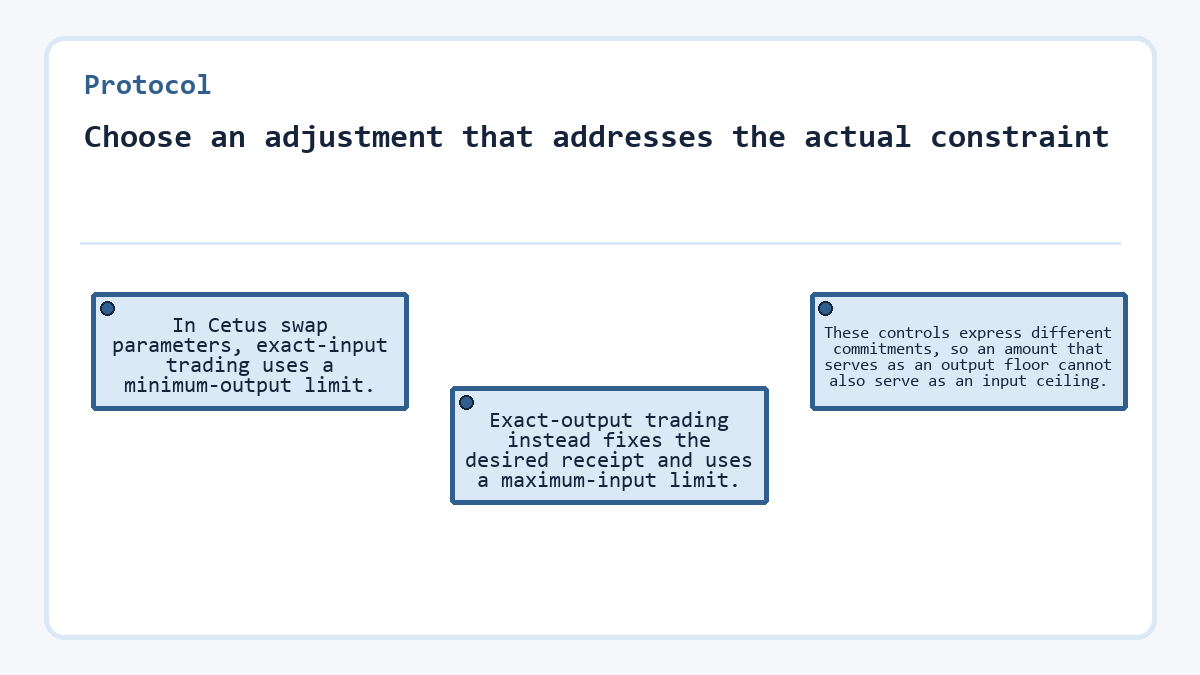
In Cetus swap parameters, exact-input trading uses a minimum-output limit. Exact-output trading instead fixes the desired receipt and uses a maximum-input limit. These controls express different commitments, so an amount that serves as an output floor cannot also serve as an input ceiling.
Separate pool fees from movement along the curve
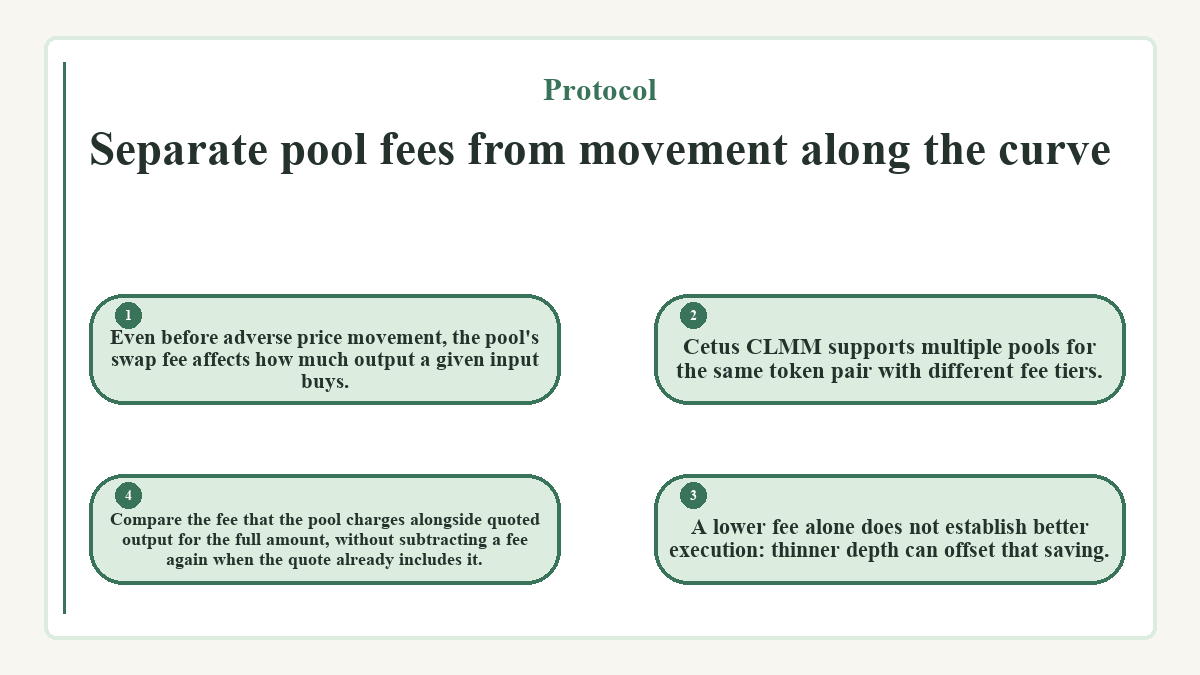
Even before adverse price movement, the pool's swap fee affects how much output a given input buys. Cetus CLMM supports multiple pools for the same token pair with different fee tiers. A lower fee alone does not establish better execution: thinner depth can offset that saving. Compare the fee that the pool charges alongside quoted output for the full amount, without subtracting a fee again when the quote already includes it.
Quote age matters because liquidity remains available to others
A quote describes pool conditions at calculation time; it does not freeze those conditions until transaction execution. Other swaps can change the starting price. Liquidity additions and removals can change depth. Either change can alter the output even when the requested input remains identical. No fixed waiting period captures every combination of activity and liquidity.
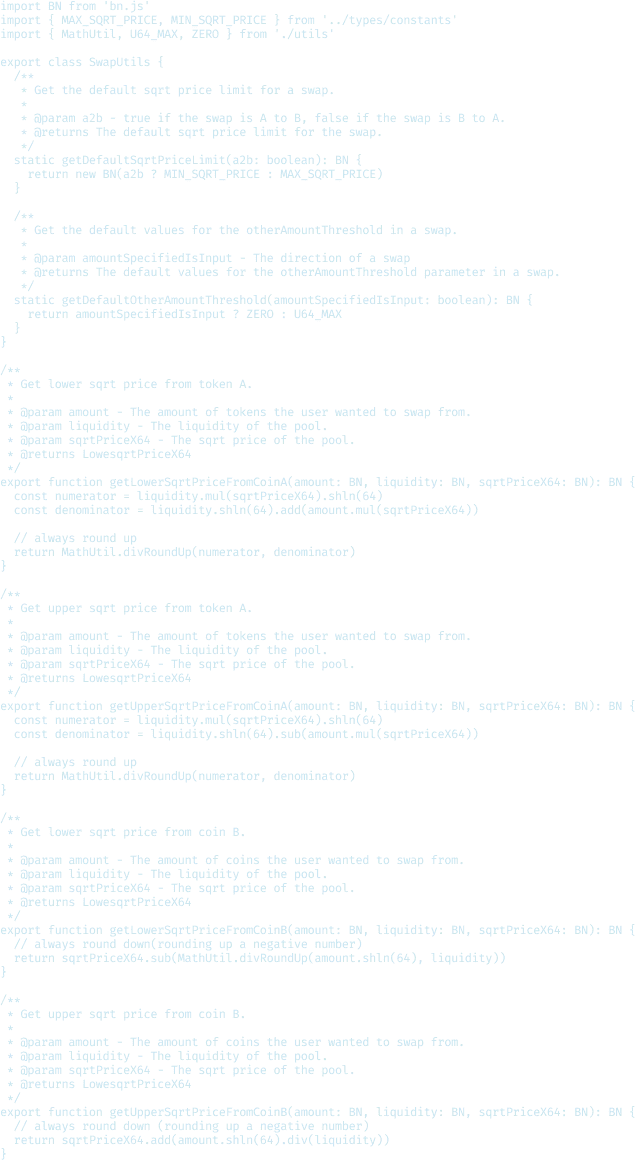
The pool follows the same pricing formula as its price and liquidity change. Slippage tolerance expresses how much execution variation the transaction accepts; it cannot establish how long a quote will remain suitable. When timing matters, the next decision is whether the refreshed output still meets the intended exchange, whether a smaller amount fits the available depth, or whether the trade should remain unsubmitted.
Still wondering about Protocol?
Does splitting a Cetus swap automatically reduce its combined price impact?
Splitting a swap does not automatically improve the combined exchange rate. Consecutive trades in the same direction move the same pool further along its price curve. Under unchanged liquidity, dividing the input does not restore the original starting price between trades. Other transactions, liquidity changes, and fees can alter the eventual comparison, so separate quotes do not establish a guaranteed saving.
Is price impact identical in both directions of a token pair?
Price impact need not be identical in both directions. Opposite swaps move through different sides of the liquidity distribution, where available depth may differ. The input amounts also use different token units. A meaningful comparison must account for direction and equivalent trade value, rather than comparing equal token counts as though they represented the same exposure.
Can smaller tick spacing eliminate price impact?
Smaller tick spacing does not eliminate price impact. It permits finer placement of liquidity boundaries, but providers must actually supply liquidity in those ranges. A pool with finely spaced ticks can still have little active depth. Spacing describes the permitted granularity of positions; the populated ranges and trade amount determine how far a swap moves the price.
Will paying a larger network fee create a better pool exchange rate?
A larger network fee does not add liquidity or change the pool's pricing curve. Network execution costs and the token exchange rate concern different mechanisms. Even where transaction ordering changes, the resulting pool state can improve or worsen the fill. Paying more for execution therefore does not establish that the same token input will purchase more output.
How can liquidity change while the displayed spot price stays the same?
Providers can add or remove liquidity without a swap moving the spot price. Those changes can alter the depth available at that price and along the surrounding ranges. Consequently, the same displayed starting rate can accompany a different quote for a substantial trade. A spot price describes an exchange ratio at a point, not the capacity available across an entire swap.
Which token units matter when checking a calculated swap rate?
Both tokens' decimal precision and the direction of the ratio matter. Dividing raw on-chain amounts without adjusting for their respective decimals can produce a misleading rate. Express input and output in whole-token units before comparing output per input token. Reversing that ratio changes its meaning, so the pool price and calculated execution rate must use the same orientation.